Saudi Rhythms: Can a Sound Library Keep Heritage Alive?
Saudi Trouq shows how field documentation can preserve regional performance while Saudi Rhythms turns that material into a planned digital layer — if release terms, credit and consent are handled with care.

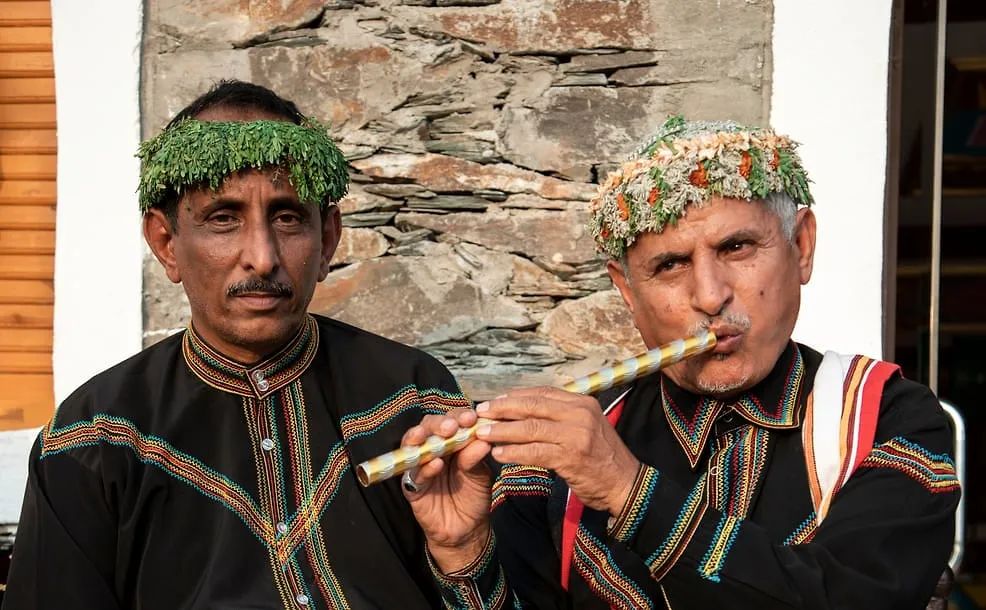
What 54 field visits found in Asir
In the 2022 fieldwork report, the clearest fact is not a slogan but a method: 54 visits across Asir’s 17 governorates, more than 200 hours of recorded material, and more than 600 people met. The same report says the team identified 65 musical and performance heritage forms in total — 49 living, 9 at risk, and 7 no longer practised.
That matters because it tells us what Saudi Trouq is really doing. It is not presenting a polished national playlist. It is documenting a regional sound world while people, places, and performance traditions are still visible in it.
Saudi Rhythms sits beside that effort as the planned digital-library layer: a proposed way to organise, describe and make some of that documented material usable for future creative work. One programme is field documentation. The other is the proposed library built on top of it.
What the December 2025 announcement adds
The December 2025 announcement from the Music Commission — reported by the Saudi Press Agency here — uses rounded figures that show the scale of the Asir source collection: 50+ visits, 60+ musical styles, and 10,000+ audio and documentary materials.
It also refers to planned packs of 80 traditional styles and 50 contemporary styles. I read those as plans, not as downloadable products, and I do not assume any licensing terms beyond what has been publicly stated. The source pages do not establish a publicly available download or licence, and that remains unverified.
The real question is not simply whether these materials exist. It is how they are framed, credited, and made legible to producers without stripping them of provenance.
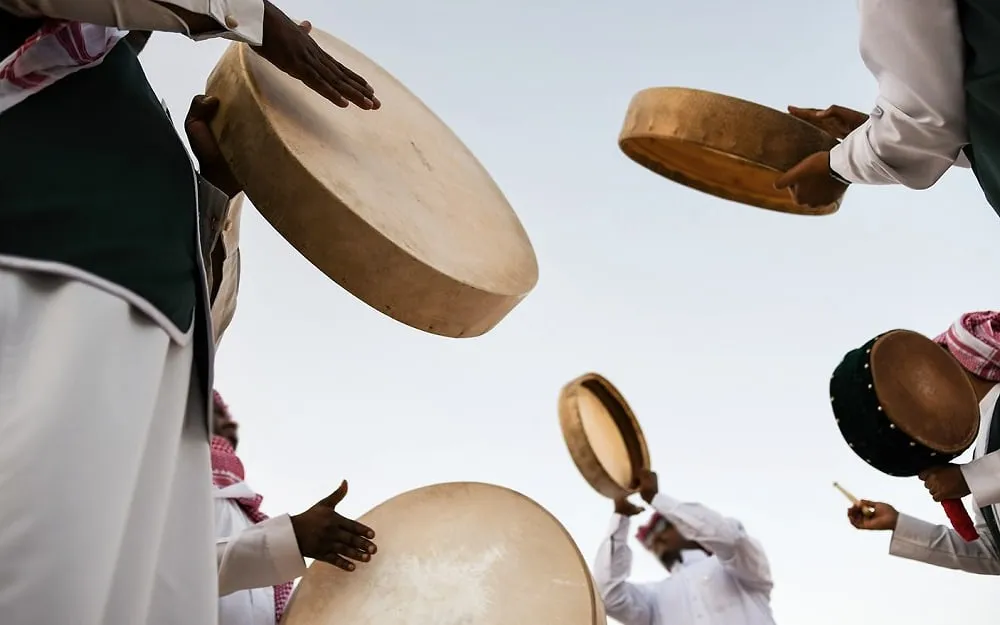 Drummers at the Winter Al Birk festival in Asir. This performance is separate from Saudi Trouq fieldwork. Photograph: Bayut Saudi; cropped and colour adjusted.
A later phase in Saudi Trouq
There is also a broader Saudi Trouq phase that pushes the programme beyond Asir. In January 2026, Arab News reported a documentation tour covering five vocal traditions across Jeddah, Makkah, Madinah, Yanbu, Al-Ahsa and Qatif, with 160 recordings.
I see that as important because it shows Saudi Trouq as an evolving documentation effort rather than a single regional project. But those recordings are a later programme phase, and I do not treat them as confirmed contents of Saudi Rhythms.
Preservation only works if practice continues
That is the part of this story that interests me most.
If heritage is preserved only as an audio object, it becomes easier to admire and harder to understand. If it remains attached to performers, communities, and use contexts, then it can continue to live as culture rather than become a detached reference library.
I think that is the right lens for Saudi Trouq. The fieldwork is not only about capture; it is about continuity. The documentation matters because it records material that can be lost. But it also matters because it shows the relationship between the performance and the people who keep it alive.
That is a more difficult project than collecting “sounds.” It requires credit, consent, metadata, and use terms that preserve context instead of deleting it.
What a producer needs to keep provenance intact
This is where the idea of sonic identity becomes concrete.
A young Saudi producer does not need another generic label stamped on top of the music. What they need is a system that keeps the origin of each rhythm and recording visible as it moves into new work. That means the library has to do more than store audio. It has to carry information.
If an authentic recording were ever released under clear terms, a producer could use it to build a track, design a cue, or create a sample-based arrangement while still retaining the original performer credit, locality, style name and permissions. But that only works if the release and use conditions are explicit.
At minimum, I would expect the material to retain:
- performer and community credit where permission allows
- the governorate or locality attached to the recording
- style name and performance context
- date and fieldwork reference
- consent and use conditions
- notes on whether a style is living, at risk, or no longer practised
These are not bureaucratic details. They are the difference between using a heritage recording as raw material and using it as a rooted source.
Without that layer, even the best archive can flatten what it was built to protect. With it, a producer can work from specificity rather than stereotype.
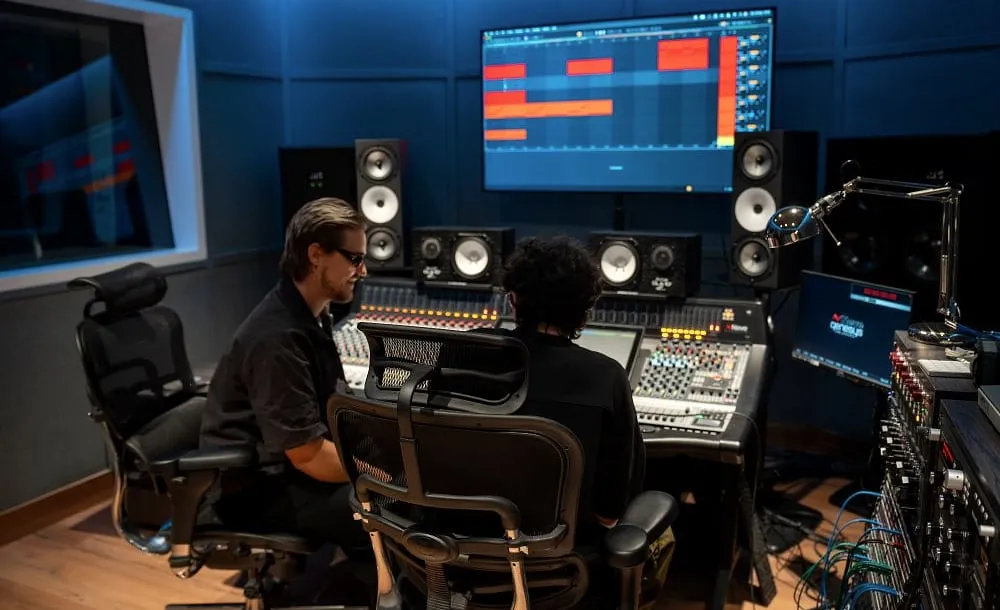 A recording session at Beast House in Riyadh, illustrative of contemporary production rather than the Saudi Rhythms project. Photograph: Arab News; cropped and colour adjusted.
Why the library layer matters
This is where Saudi Rhythms becomes more than a storage solution.
A planned digital library can make fieldwork useful in contemporary production without pretending that the archive itself is the music. The value lies in curation and structure: the way materials are sorted, named, and contextualised so that a composer, sound designer, or producer can understand what they are hearing before they decide how to use it.
That is a much stronger proposition than the vague promise of “inspiration.” It gives creators a way to build with material that carries place-based meaning.
It also creates a more honest relationship between tradition and innovation. The goal is not to modernise heritage until it disappears. The goal is to let new work emerge from living cultural practice while keeping that practice recognisable.
What should not be lost in the process
The temptation in projects like this is to talk about preservation as if the archive were the endpoint. I do not think it is.
The endpoint should be continued practice: performances that still belong to people and communities, not only to institutions and folders. If the documentation is done well, it can support that by making the tradition easier to learn, easier to reference, and easier to respect.
But the archive should never become a substitute for the living culture it records.
That is why the figures from Asir matter so much. The report’s 54 visits, 200-plus hours, and 600-plus meetings suggest a process grounded in contact rather than extraction. The December 2025 announcement suggests a larger digital future. The challenge now is making sure that future still shows its sources.
A better test than scale
The scale is impressive. The more important test is whether the system preserves attribution, context, and consent as material moves from fieldwork into library form and then into creative use.
If that happens, Saudi Rhythms and Saudi Trouq can do something rare. They can help build contemporary Saudi music from within its own documented inheritance, not by borrowing a flattened regional aesthetic.
That would be preservation through continued practice, which is a more demanding idea than preservation through storage.
And it is the one that keeps performers and communities visible, where they belong.
Hero photograph: musicians in Asir, Soudah Development; cropped and colour adjusted. The people pictured are not identified as Saudi Trouq participants.