Riyadh’s Real Comedy Scene Is Being Built One Small Room at a Time
Imported headliners can fill venues, but durable stand-up depends on small rooms, repeat audiences and Arabic material that local comics can keep refining.

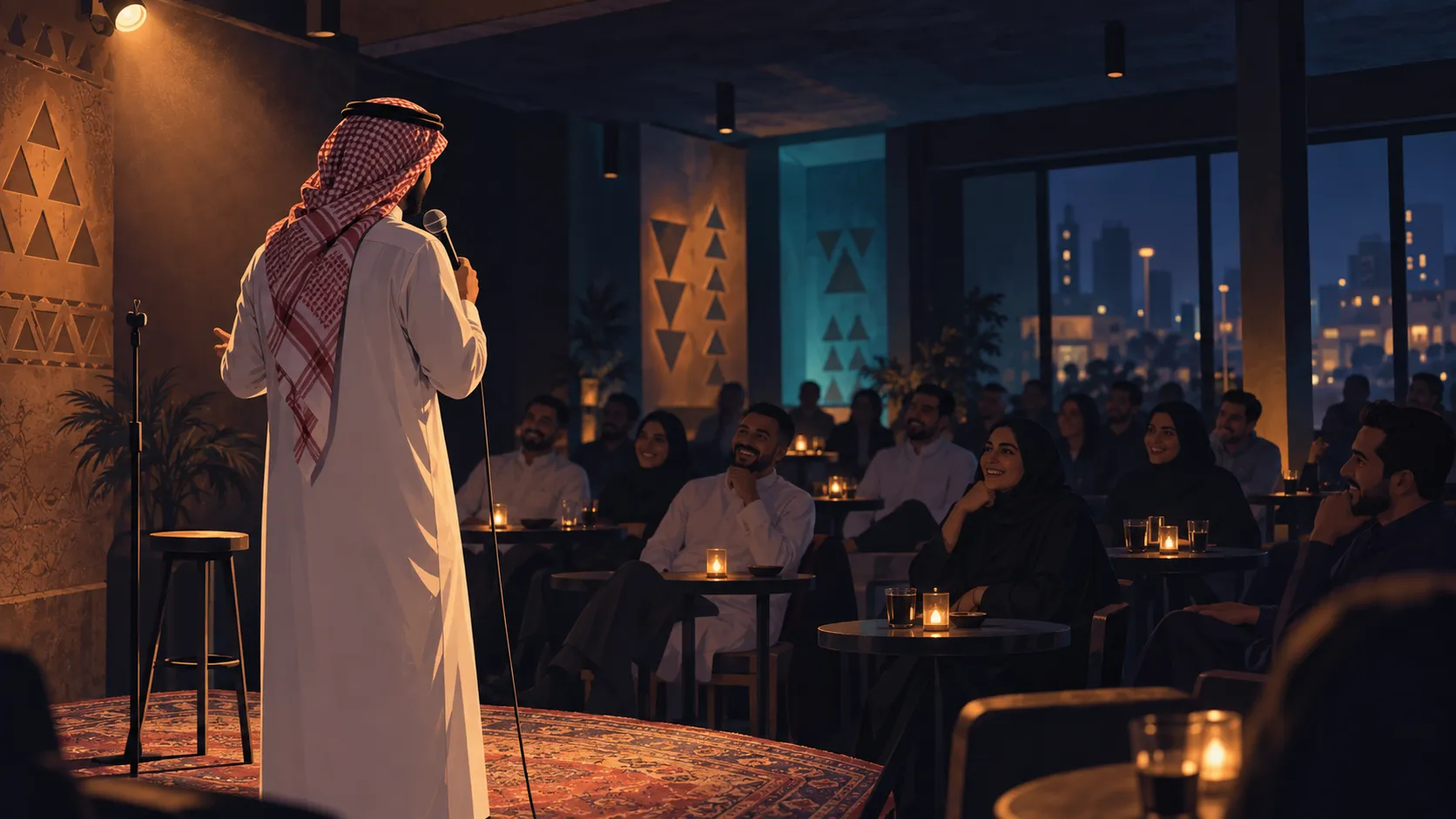
The forward calendar says more than any headline does
As of 11 September 2026, Riyadh’s comedy listings already point to a busy autumn. Platinumlist’s Riyadh comedy page shows 3a Ka3ba on 18 September; Khaled Jwad and a Qiddiya bill led by Mohamed Helmy with Saudi comedians Radwan ElRemi and Abdulrahman Abo Elregal on 25 September; a four-comedian Qiddiya bill on 26 September; Tony Abou Jaoude on 1 October; Alaa El Sheikh on 15 October; FEENA NEHKE? on 22 October; and Nemr on 6 November.
That breadth matters. It shows demand, range and a widening market for Arabic stand-up. But it still does not answer the bigger question of whether Riyadh has a real comedy scene or only a series of notable bookings.
To me, the distinction is simple: spectacle can introduce comedy. It cannot build a scene by itself.
Major international bills attract attention, create a reference point and signal that stand-up is now part of the city’s mainstream entertainment calendar. But a comedy scene becomes real only when there are enough small rooms to let comics repeat the basic work of the form: writing, testing, failing, tightening and returning.
The small room is the real institution
The strongest evidence of a developing scene is not a single headline event. It is the existence of regular rooms with repeatable formats.
Comedy Pod, which says it was founded by Riyadh-based comedy enthusiasts, appears to be one of the clearest examples. Its site describes regular Arabic- and English-language stand-up nights and a focus on up-and-coming comedians.
That matters more than any single marquee show. In comedy, stage time is the currency, but not all stage time is equal. A test room is different from a showcase; a showcase is different from a paid public bill; and a paid bill is different again from a festival slot. If Riyadh is building a scene, it is because some organisers are already thinking in that sequence.
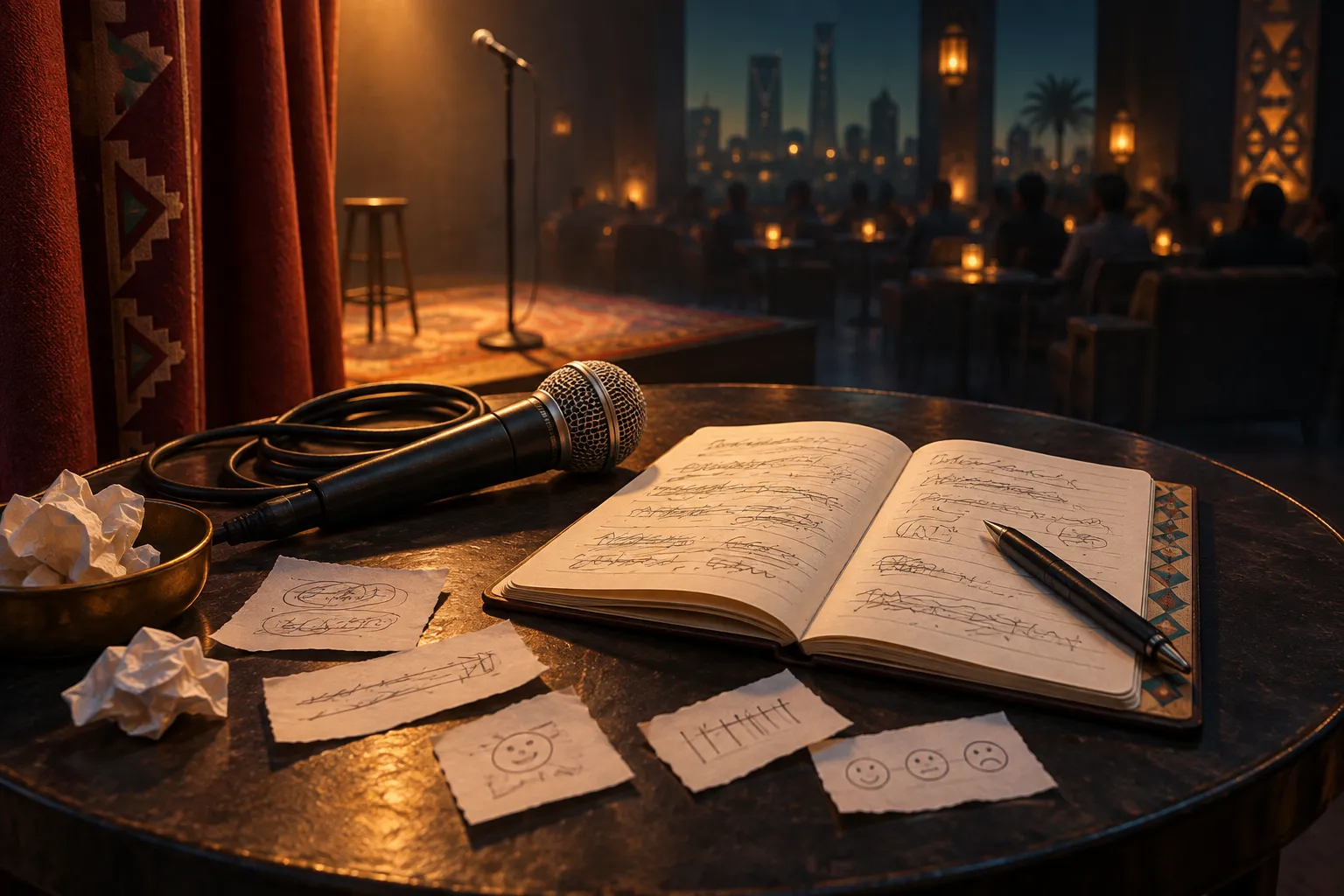 A comedy scene compounds through repetition: write, test, listen, rewrite.
Arabic is not a cosmetic choice. It is the operating system.
One of the most important shifts in Riyadh stand-up is linguistic.
Arabic appears to have changed the equation. Comedy Pod’s emphasis on Arabic is not just a localisation tactic. It is infrastructure.
Why? Because a comedy room depends on shared references. Dialect carries timing, cultural shorthand and social nuance that can make a joke land faster and more truthfully. It also lowers the barrier between performer and audience. The set becomes less about performing an imported format and more about speaking in a recognisably local rhythm.
That does not make English stand-up irrelevant. Bilingual rooms can widen the pool of performers and audiences. But if Riyadh stand-up is to become durable, Arabic has to do more than coexist with English. It has to be the medium through which the city’s comics develop point of view, voice and identity.
Visit Saudi’s listing for “New Jokes” from Exit Thmanyah is the strongest recurring local signal. It describes a weekly Wednesday testing night at Comedy Pod where rising comedians test new material, with lineups announced on Instagram and tickets starting at SAR 75. Weekly testing nights are exactly the kind of rhythm that turns comedy into practice rather than performance-only spectacle.
A scene needs a path, not just a stage
The pattern that interests me most is the possible route from beginner to working comic.
In the reporting, I see a path that looks like this:
- Open mic or test night
- Small public room with feedback
- Larger showcase or recurring bill
- Mixed-venue appearance
- Work in writing, content or touring
That is not proof of a full labour market. It is only an early route. But it is the difference between a one-off entertainment trend and a scene with long-term value.
Arab News reported that one participant moved from flight engineering into a Telfaz11 content-writing job after several months, while another known as Brown became a full-time comedian. Those are anecdotal examples, not evidence of a broad industry. Still, they suggest how stand-up can connect to the wider content economy. In a market where visibility is often linked to digital media, comedy may become both a live format and a talent pipeline for writing, production and on-camera work.
That is important because stand-up careers rarely survive on stage fees alone at the beginning. The more closely comedy rooms connect to content studios, recorded specials, social clips, podcasting and live touring, the more possible it becomes for performers to stay in the craft.
“This platform has made me a better performer, a better writer.” — Sary Al-Khalid, speaking to Arab News
The bottlenecks are visible already
If Riyadh is in the building phase, the weaknesses are visible too.
The first bottleneck is the number of dependable rooms. A scene cannot rely on one or two venues forever. It needs enough recurring spaces that comics can keep experimenting without waiting for the next big bill.
The second is discoverability. Much of what seems to happen in the current ecosystem is announced through social media, which is useful but unstable. If a room depends too heavily on Instagram posts and word of mouth, it can be hard for new audiences to find it consistently.
The third is economics. I have not seen enough to conclude that stand-up in Riyadh already supports many full-time careers on stage income alone. What is more visible is a hybrid model: comics performing live while also moving into writing or other content work. That is not a weakness in itself, but it does mean the scene still needs clearer commercial pathways.
The fourth is creative range. Any developing comedy ecosystem has to work out where its boundaries are and how performers navigate them. That can affect writing style, club programming and how boldly comics take risks on stage.
The fifth is representation. A durable scene needs more women and more varied voices on stage and behind the scenes. The reporting names performers such as Sary Al-Khalid, and those names matter because scenes are built by people who return, not by one-off appearances.
Bigger bills show the market is widening
There is also evidence that Arabic comedy is moving beyond small rooms and into larger commercial bills, though I would still read that as market expansion rather than proof of a mature grassroots pipeline.
Current September 2026 ticket listings show comedy reaching larger Qiddiya bills. One 25 September Qiddiya City listing features Mohamed Helmy with Saudi comedians Radwan ElRemi and Abdulrahman Abo Elregal. Another 26 September listing features Saleh El Nawawy, Saif Zaghmouri, Abdulla Sbeih and Talal Al Sheikhe.
I would not confuse that with proof that the grassroots ecosystem is already self-sustaining. A larger bill can mean demand is broadening, but it does not automatically mean the local development pipeline is deep enough. The stronger reading is more modest and, to me, more interesting: Arabic stand-up is no longer confined to a handful of intimate rooms. It is appearing in more visible commercial formats, which implies a wider market is forming around it.
That matters because commercial bills and club nights are not substitutes for one another. The market creates scale. The club creates repetition. If Riyadh’s comedy economy is going to last, both have to work together.
What would prove the scene is self-sustaining?
Over the next two to three years, I would look for a simple scorecard.
- More recurring rooms with stable weekly schedules
- More local headliners, not just imported names
- More Arabic and bilingual lineups
- More women on stage and behind the scenes
- More cross-city touring, not only Riyadh-only bills
- More recorded releases, clips and specials that extend the life of a set
- More clear paid pathways into writing, production and content
If those markers begin to stack up, then Riyadh’s comedy story will be about more than a programming wave. It will be about a functioning ecosystem.
That is why I think the small room deserves more attention than the big announcement. Major bills may create awareness. Small rooms create comedians.
And in Riyadh, that distinction is the whole story.