Al Dahra’s Saudi partnerships put feed distribution in focus
MOUs with Dar Al Alaf and Al Mutawa aim to extend forage and feed access, highlighting the distribution networks behind Saudi livestock and dairy production
Getting feed to livestock and dairy producers is part of the work behind food supply. Al Dahra’s latest Saudi partnerships put that distribution task in focus, with two local companies expected to help the agribusiness extend its reach across the Kingdom.
On 22 October, the Abu Dhabi-headquartered agribusiness announced that it had signed two memoranda of understanding with Saudi companies Dar Al Alaf and Al Mutawa during Saudi Agriculture 2026 in Riyadh. The agreements are intended to widen access to forage and feed across the Kingdom, linking Al Dahra’s sourcing network with established local commercial channels. They form part of the company’s regional commercial expansion strategy under the leadership of Wissam Abbas, Managing Director of Al Dahra GCC.
Forage is plant material such as hay or alfalfa fed to livestock. In a market where dairy and livestock production depend on steady input flows, the availability of that feed is a basic operating issue. Al Dahra says Saudi Arabia consumes an estimated 5 million metric tonnes of forage annually and that it currently accounts for about 17% of the Kingdom’s forage imports. The two company figures measure different things: total forage consumption and Al Dahra’s share of imports. The 17% figure is not a share of the whole Saudi forage market. Together, they provide context for the company’s interest in expanding its distribution reach.
Al Dahra says it already has a Riyadh office, warehousing capabilities and commercial coverage across the Kingdom. The new MOUs sit on top of that footprint and appear aimed at extending how the company connects its sourcing and logistics base to local customers.
Connecting sourcing with local distribution
For food and beverage readers, the relevance sits upstream of dairy and livestock output. A sourcing network gives a supplier access to products; local storage and distribution help connect those products with producers. On Al Dahra’s account, these partnerships are intended to strengthen that connection through Saudi businesses already serving the sector.
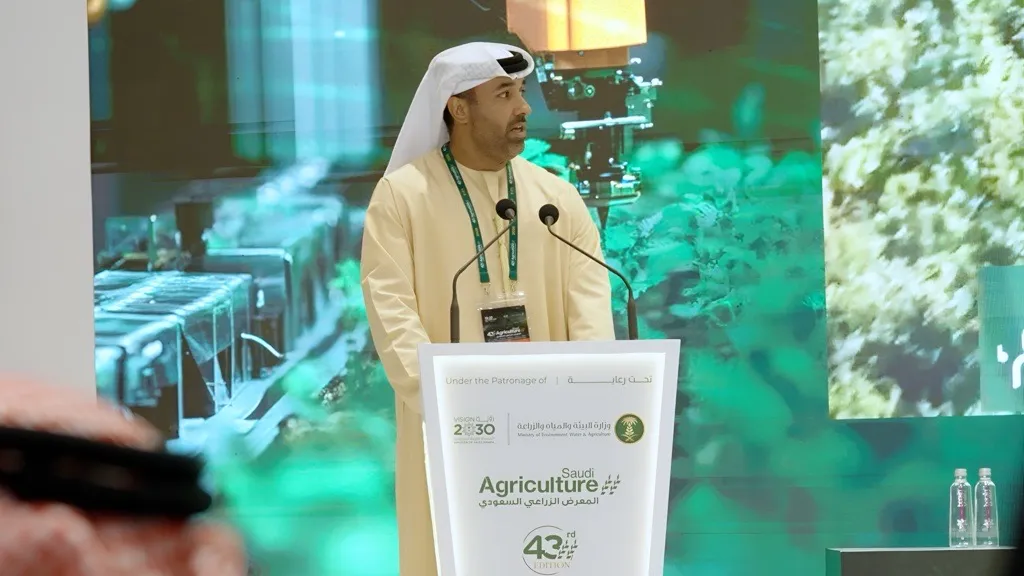
Ahmed Al Suwaidi, Chief Corporate Affairs Officer at Al Dahra, addressed that connection in his keynote at the event:
“Agricultural resilience today depends on much more than production alone. It requires integrated value chains that can adapt to changing climate conditions, shifting trade patterns and evolving market demand.”
His remarks connected resilience with public and private sector collaboration, investment in technology and infrastructure, and supply chains able to adapt to changing climate conditions and trade patterns. The distribution agreements give that discussion a specific commercial setting, although their effect will depend on implementation.
The producer’s use of feed is another part of that chain. Hosam Al Zahal, Forage Sales Director at Al Dahra, was scheduled to join a panel on next-generation livestock farming and production optimisation. The planned discussion would examine advanced nutrition, forage quality and technical expertise in helping dairy and livestock producers improve productivity and feed utilisation in challenging climatic conditions.
What remains to be seen
Al Dahra has not disclosed agreement values, committed volumes, named coverage regions or an implementation timetable. The scale of the expansion therefore remains unclear, as does any effect on feed prices or downstream food costs.
We would assess progress through the coverage the partners establish and the volumes actually supplied. Those details would show how far the MOUs extend access for livestock and dairy producers beyond Al Dahra’s existing Saudi footprint.