Saudi travel demand is shifting inward — and becoming more connected
Almosafer booking data for January–July 2026 versus the same period in 2025 points to a traveller base booking more domestically, more quickly and with more connected trip components.

Saudi travel demand looks resilient, but it is also changing shape
Almosafer’s Insights & Trends of the Saudi Traveller report offers a useful read on how travel behaviour shifted across proprietary Almosafer consumer-channel bookings from 1 January to 31 July 2025 versus the same period in 2026. Flight metrics are segments, hotel metrics are room nights, and percentage changes are rounded to whole numbers. The picture it paints is not one of contraction. It is one of reallocation.
I see demand as having reorganised around domestic depth, shorter booking windows, add-on products and more connected itineraries. Travellers still moved, but they seemed to be choosing destinations, channels and products that offered more flexibility and convenience.
“What this year showed us is the resilience of the Saudi traveller. Despite the geopolitical challenges across parts of the wider region, travel continued — differently, not less.”
— Muzzammil Ahussain, Chief Executive Officer of Almosafer Travel & Tourism Co.
Domestic travel became the centre of gravity
The strongest signal in the report is domestic travel. Almosafer says domestic bookings accounted for 46% of all bookings, with domestic bookings up 13% year on year.
The split by product type makes the shift even clearer:
- Domestic flight segments grew 8%
- Domestic room nights grew 44%
- Religious stays grew 53%
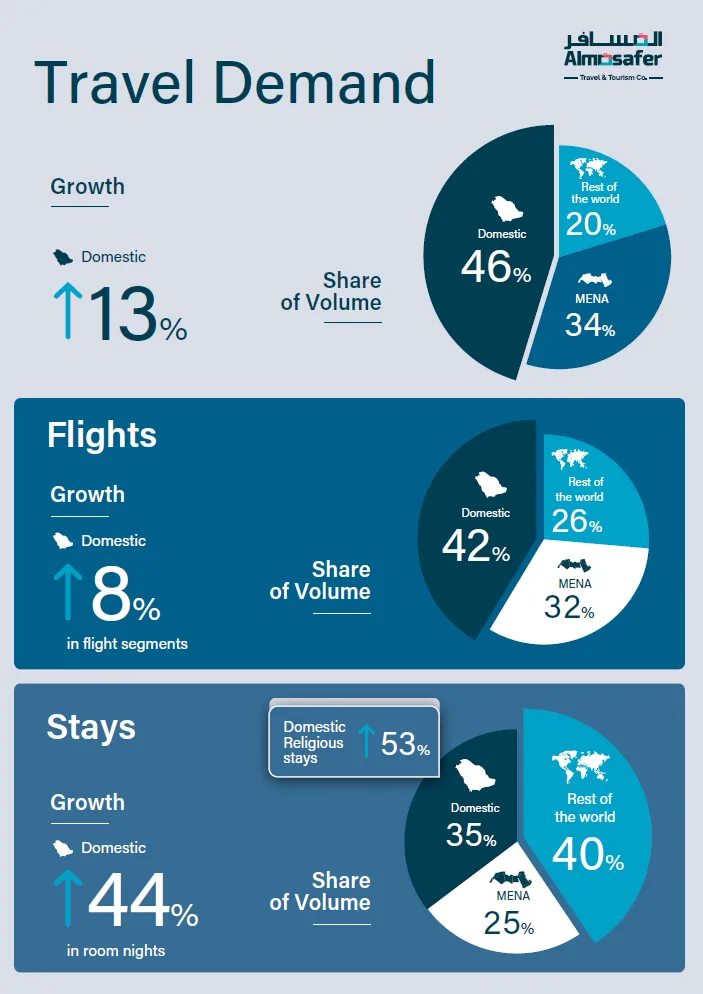
That combination suggests more than a simple preference for staying close to home. It points to a market where domestic travel is being used for several different purposes at once: religious travel, leisure breaks and shorter, repeatable trips.
Makkah and Madinah provided scale, while the Red Sea emerged as a breakout destination in the report. Red Sea room nights grew by more than 4,000%, and the destination recorded the highest average order value of any destination Saudi travellers booked globally, ahead of Paris and London.
Other domestic destinations that trended in the report included Aseer, AlUla, Taif, Jizan and KAEC, while Riyadh, Jeddah and AlKhobar remained core favourites.
International demand also widened
The report also shows that international demand remained broad rather than narrowing to a single pattern. Established favourites included Cairo, Doha, Dubai, Manama, Istanbul, Phuket, London and Paris.
Trending destinations in the report included Egypt’s North Coast and Red Sea Coast, Tangier, Marrakesh, Moscow, Athens, Madrid and Shanghai. I would treat these as signals within Almosafer’s booking data, not as market-wide rankings.
The market favoured speed, flexibility and shorter planning cycles
The booking window was 11 days, and 67% of flight and stay bookings were made within a week. That is a short planning horizon by any standard, and it reinforces the idea that travellers are responding to convenience and immediacy.
There were some useful nuances by segment:
- International family stays were booked an average of 19 days ahead
- International flights averaged 17 days in advance, down from 19 days in 2025
That suggests some categories still reward earlier planning, but the broader market is clearly moving toward faster decisions.
The report also indicates that travellers are making those decisions through a more flexible booking mix. Low-cost carriers accounted for 60% of flight segments, while national airlines rose to 57% of all flight segments, up from 49% in 2025. National airlines carried 33% of international segments.
I read that as a traveller base balancing network reach, convenience, trip timing and trip purpose.
Add-ons are becoming part of the booking habit
One of the most striking parts of the report is the growth in ancillary and convenience-led purchases.
According to Almosafer, activity bookings grew 464%, while connected bookings — trips linking a flight or stay to an activity or transfer — grew 368%.
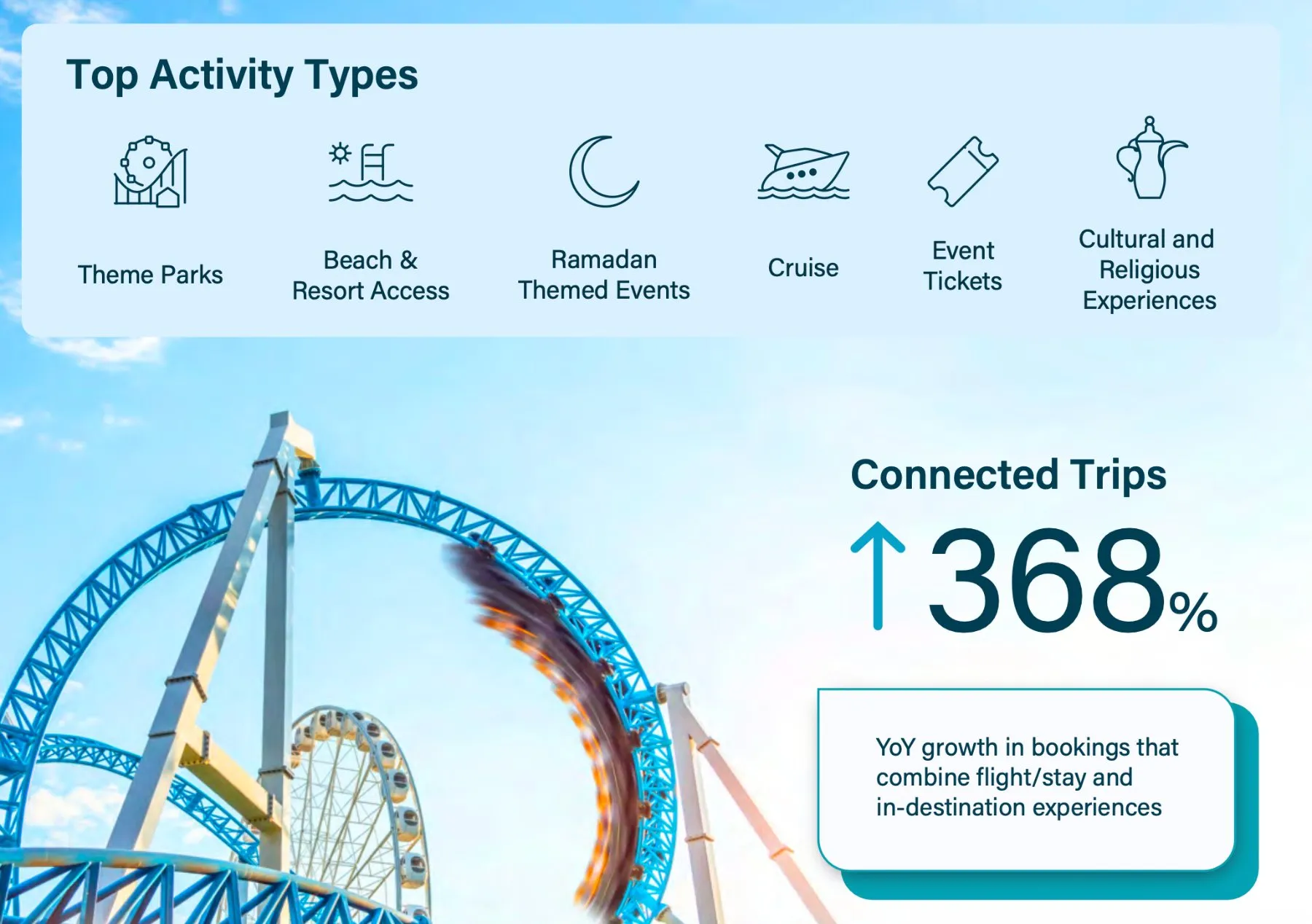
The city-level growth figures underline how concentrated this behaviour can be:
- Riyadh activity bookings rose 2,061%
- Jeddah rose 664%
- Makkah rose 1,193%
That is a strong signal that travellers are not only booking transport and rooms. They are increasingly stitching together the full trip in one flow.
The same pattern appears in protection and service products:
- Protection adoption grew 154%
- Protection purchases grew 165%
- Baggage recovery grew 474%
- Trip insurance grew 132%
- Cancellation freedom grew 21%
Almosafer says more than 20% of bookings added a convenience product. In other words, a meaningful share of travellers appear willing to pay for reduced friction.
For operators, the implication is clear: platforms can create value by connecting transport, stays, activities, transfers, protection and flexible payments in one booking journey.
Hotels and accommodation also show a premium tilt
The accommodation mix in the report also points to a traveller willing to spend for comfort.
Four- and five-star hotels accounted for 74% of room nights, while alternative accommodation grew 21%.
That combination does not suggest a simple move toward budget travel. Instead, it suggests a bifurcated market: premium hotel demand remains dominant, while alternative stays are also finding room to grow.
Channels and payments show a digital-first traveller
The report’s channel and payment data reinforce the idea that Saudi travel demand is increasingly digital and app-led.
- App bookings accounted for 77%
- Web bookings accounted for 17%
- Retail bookings accounted for 6%
- Apple Pay accounted for 44%
- Easy financing, including BNPL, reached 29% of bookings
Retail average order value was 3.3 times online, which is a reminder that some customers still use physical channels for higher-consideration bookings. But the broader picture is clear: the main booking behaviour has moved online, and it is being supported by faster, embedded payment options.
Almosafer also says its native AI filters were used by 21% of travellers offered the feature, and that it has integrations with ChatGPT and Claude. That is worth watching, because discovery is becoming part of the booking funnel itself. If travellers are using AI to narrow choices, then the next competitive edge may be relevance at the point of search, not just price at checkout.
What this says about the Saudi travel market
My read of the report is that Saudi travel demand has become more selective, more digital and more experience-led, but not weaker.
The dominant themes are:
- Domestic travel is absorbing more demand
- Connected trips are becoming normalised
- Convenience products are gaining traction
- Booking windows are shortening
- Premium accommodation still leads, but flexibility matters
- Digital channels and payments are now the default
That is a meaningful market shift. It suggests that operators, airlines, hotels and travel platforms need to think less about travel as a single booking and more about the full set of decisions around it: where to go, how quickly to book, how to combine trip components and how to reduce friction once the traveller is ready.
For me, the most important takeaway is that resilience does not always look like a return to old patterns. Sometimes it looks like a market quietly rewiring itself around the options that feel easiest, safest and most useful.
If Almosafer’s data is any guide, that is exactly what Saudi travel is doing now.