Tourism Gulf
Synthetic Audiences Could Become a New Pre-Launch Layer for Gulf Communications
Burson’s acquisition of Limbik points to a bigger shift in communications: from measuring audience reaction after launch to simulating it before a campaign enters the market.

Burson’s acquisition of Limbik points to a broader shift in communications, moving from measuring how audiences reacted after a message is published to trying to anticipate that reaction before it goes live.
Burson says Limbik’s Decipher technology uses cognitive AI and synthetic audience simulation to forecast how communications will resonate, including the believability and virality of messaging before it reaches the market. The significance goes beyond a new tool. It suggests predictive audience work is being positioned as part of the core communications workflow, not as a side experiment.
What interests me is how this changes the timing of audience insight. Traditional research has usually sat in two places: post-launch measurement, when teams are trying to understand what happened, and pre-testing, when they are checking creative before release. Synthetic audience simulation extends pre-testing by making it faster, more scalable and potentially more granular. In theory, it allows teams to pressure-test multiple narratives and audience scenarios before a campaign enters the market.
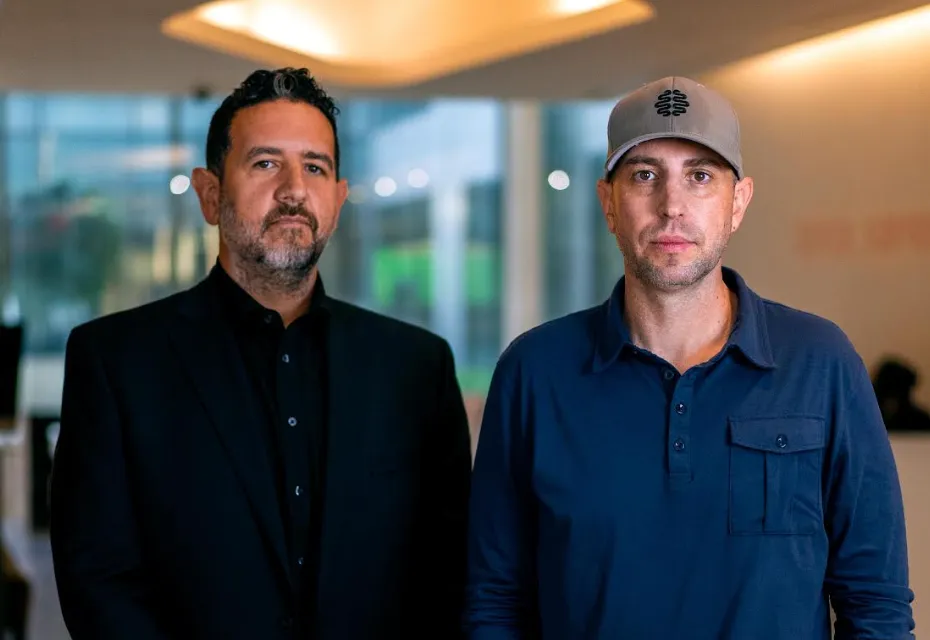 Limbik co-founders Zach Schwitzky and Josh Levin, whose cognitive AI technology powers Burson’s Decipher predictive intelligence platform.
Why this matters in the Gulf
I think this is especially relevant in the Gulf because many campaigns are not written for a single, tidy audience. A destination launch, for example, may need to speak to Saudi residents, GCC travellers, Western tourists and Asian source markets at the same time. The message may be broadly consistent, but the way people interpret it can vary a lot.
That is where synthetic audience testing becomes interesting. It could help communications teams compare different versions of the same campaign and see which claims feel credible, which wording creates skepticism, and where cultural interpretation changes the meaning rather than just the translation.
A message about luxury may need to feel exclusive in one market and accessible in another. A claim about authenticity may need to be grounded in heritage for one audience, while another may care more about modernity, convenience or discoverability. Sustainability can read as a trust signal in one context and as a vague marketing phrase in another. The point is not that one message can satisfy everyone. The point is that the trade-offs become visible earlier.
From measurement to simulation
What struck me most in this development is the shift in timing. Communications teams are used to measuring outcomes after the fact: reach, sentiment, engagement, share of voice, maybe even reputation impact. Those are still useful, but they are lagging indicators.
Synthetic audiences suggest a different layer altogether. Instead of waiting for the market to react, teams can ask: how might this audience respond if we launch now? Where could misunderstanding emerge? Which words are likely to be read as bold versus overpromising? Which visual cues could be interpreted differently across languages or cultures?
I can see the appeal. For large campaigns, especially in destination marketing, hospitality, aviation or public-sector communications, a bad launch can be expensive not just financially but reputationally.
That is why the nuance matters. I do not think these tools can reliably predict what “Saudi consumers” or any other broad demographic will think. Audiences are heterogeneous, and context changes quickly. The value is less about generating a definitive forecast than about exposing assumptions, possible failure modes and questions worth validating with real people.
Where the promise is real — and where it is not
This matters because modern communications is increasingly cross-cultural and multi-channel. A campaign may launch in Arabic and English, across paid media, social, search, outdoor and owned channels. A message can be technically correct and still fail because the tone feels off. It can be translated accurately and still lose the emotional logic that makes it persuasive.
“This work isn’t a separate service line item anymore. It’s foundational to every piece of client work we do.” — Corey duBrowa, CEO, Burson
The way Burson is framing the technology is telling. Predictive AI is being positioned not as a standalone experiment, but as infrastructure embedded across the communications workflow.
But infrastructure should not be mistaken for certainty. A model may be built on historical patterns, yet the context around communications can change quickly. A phrase that seemed persuasive last month may feel outdated after a policy change, a social conversation, a competitor move or a shift in public mood. Models can also flatten audiences into neat categories that look precise on a dashboard but are far messier in reality.
From advantage to infrastructure
What I find most plausible is that this kind of tool stops being a novelty and starts becoming part of the standard pre-launch process, the same way brand safety checks, media verification and measurement frameworks became more normal over time.
For organisations shaping perception in the Gulf, that would be a meaningful change. It would mean campaigns are no longer judged only by how well they perform after launch, but also by how carefully they were designed before launch.
I think the competitive advantage will not ultimately come from simply having access to synthetic audiences, especially if these tools become widely available. It will come from knowing which audiences to model, which assumptions to challenge, what the model may be missing and when to validate its output with real-world research.
That, to me, is where the real value lies: not in replacing human judgment, but in sharpening it before the market has the final word.